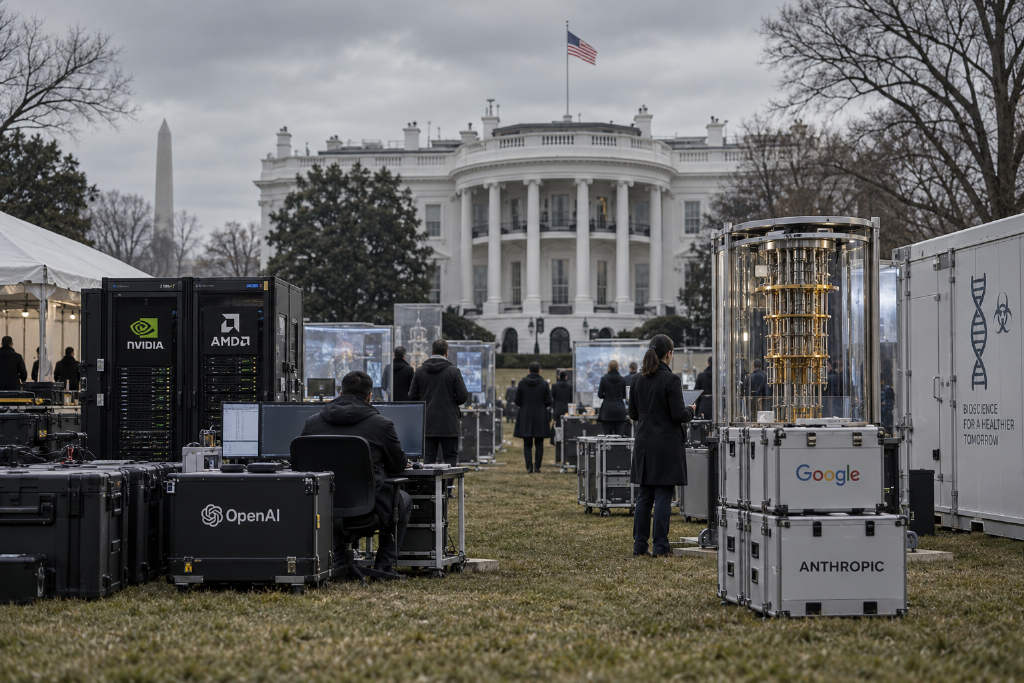
White House2026-10-09 03:22:27White House Unveils Research Package Exceeding $6 Billion Across AI, Quantum, and BioscienceThe White House has announced a broad research package worth more than $6 billion, spanning artificial intelligence, quantum computing, biological research, and talent development. The funding and resources will come from government bodies, companies, universities, and philanthropic organizations. As part of the package, 11 technology companies committed $2.4 billion in AI tools and compute credits for the Genesis initiative. The disclosed pledges include $1 billion from Nvidia, $500 million from AMD, $200 million from OpenAI, and $150 million each from Anthropic and Google. These resources are set to support research work across more than 15 federal agencies. The Genesis initiative is scheduled to launch in 2025 and will use AI, supercomputers, and government research data to speed up work in energy, healthcare, aerospace, and other fields. The broader set of arrangements also includes a previously announced $1.8 billion virtual biology initiative, along with $1 billion in research computing capacity and talent training investment pledged by the state of Georgia, companies, and universities.230
South Korea2026-10-06 02:47:48South Korea plans $3.5 billion frontier AI model project starting in March 2027South Korea’s Ministry of Science and ICT said the country plans to launch a 4.7 trillion won frontier artificial intelligence model development project in March 2027, a program valued at about $3.5 billion. The ministry said the initiative is intended to help South Korea secure a place in the race for cutting-edge AI. The project still depends on the National Assembly approving the 2027 budget in December. After that, the government plans to choose a lead developer through an open bidding process, with the winning bidder potentially announced as early as February. South Korea said it will combine state equity investment with private capital for the effort. It also plans to concentrate computing chips, data, and talent into the project. The program will be open to a range of participants, including a single company, business consortiums, and special purpose entities. The government said it wants startups, companies, universities, and researchers to play leading roles in the initiative.270
UCLA2026-08-03 22:29:02UCLA marmot researchers turn to OnlyFans for funding as meme coins pop up on Pump.funA long-running wildlife study at the University of California, Los Angeles has found an unusual funding path: OnlyFans. The UCLA team behind a yellow-bellied marmot research project in Colorado, which has been running since 1962, launched an account called OnlyMarms after traditional research funding became harder to secure. Professor Daniel Blumstein said the page has brought in about $4,000 so far, though the project still needs $75,000 to $100,000 a year to support graduate students and fieldwork. The fundraising effort has also spilled into crypto. Several meme coins inspired by OnlyMarms have appeared on Pump.fun, but Blumstein told NPR that the UCLA researchers did not create the tokens. He said people independently launched a meme coin and suggested the team register it so they could collect transaction fees. The project has also expanded beyond subscriptions, including a partnership with a Colorado brewery on a “Marmot Tears” IPA and a public “Fat Marmot Week” competition. Blumstein said the need to raise money through platforms like OnlyFans shows how far scientific funding in the United States has shifted from the federal grant support that once sustained research like this.860
US science2026-07-24 07:15:15Nature Warns Trump’s Funding Freeze Is Shaking the Foundations of US ScienceNature says more than 7,800 research grants have been canceled or frozen since Trump returned to office, while about 25,000 federal science workers have left and major budget cuts are under review.320
Cardano2026-07-23 19:50:15Charles Hoskinson warns Cardano may lose scientists if research funding cutCardano founder Charles Hoskinson warned the network could lose its scientists after Japanese dReps voted against a key research funding proposal. The dispute tests Cardano's science-first brand amid ADA market pressure.550
Bio Protocol2026-07-03 15:31:39Bio Protocol Launches OpenLabs as a Human-Agent Coordination Layer for Scientific ResearchBio Protocol has introduced OpenLabs, a new coordination layer designed to connect human researchers and AI agents in scientific workflows. The platform is intended to turn scientific ideas into fundable, executable projects rather than leaving them at the discussion stage. According to Bio Protocol, the DeSci sector has already shown that communities can coordinate capital and data at internet speed, while agents are increasingly becoming practical collaborators capable of reading papers, running queries, drafting hypotheses, and designing experiments. OpenLabs is structured around five connected layers: posts and discoveries, projects, agent collaboration, a Web3 incentive layer, and a bounty system. On the funding side, the protocol plans to use a USDC yield-based mechanism, allowing users to deposit USDC and support selected projects. Those funds are intended to be deployed into audited yield vaults such as Morpho and Aave, with generated yield directed to project expenses including compute, queries, and simulations, while principal is stated to remain at no risk. Once a project reaches a stage that requires real capital, Bio says it can proceed through the Bio launchpad for token issuance or pursue private fundraising and a more traditional biotech route.2200
Bio Protocol2026-07-03 14:36:21Bio Protocol Launches OpenLabs to Fund AI Agent Research Collaboration Through USDC YieldBio Protocol has officially launched OpenLabs, a DeSci coordination layer designed to connect scientific ideas with funding execution on a single platform. The product is built to let human researchers and AI agents collaborate in shared research workflows rather than treating funding, discussion, and execution as separate stages. Researchers can publish hypotheses or discussion posts first, and after community validation through voting, those proposals can be upgraded into formal projects with structured collaboration tools. OpenLabs then provides project workspaces, bounty-based task systems, and AI agent support to help teams move research forward. Mature projects may later raise capital through the Bio Protocol launchpad. On the funding side, OpenLabs introduces a USDC yield-based mechanism: users stake USDC and choose which projects to support, while the capital is deposited into audited yield vaults such as Morpho and Aave. Principal is intended to remain untouched, and only the generated yield is directed to projects. According to the announcement, that yield is meant to cover AI-related operating costs including inference and tool usage. OpenLabs is now live, and the first batch of projects is already displayed on the platform.2040